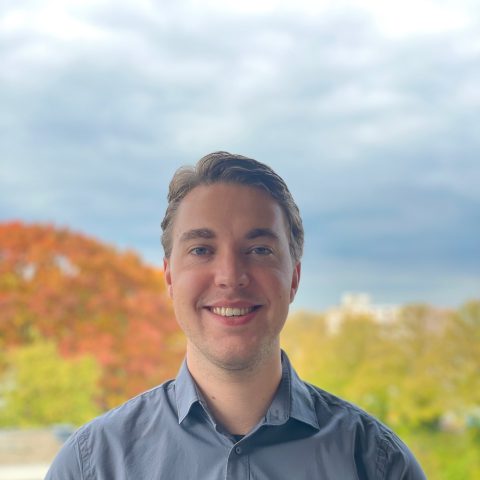
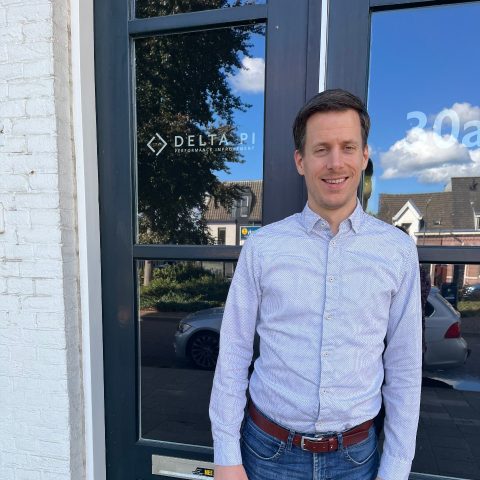
Meet our new partner at Delta Pi: Kwin Woerdeman.
For years, he was one of our clients through ProRail and Schiphol. Recently, however, he has been sitting on the other side of the table. Kwin Woerdeman (1981) is currently co-owner of Delta Pi. His focus is primarily on the integration of IT company Ippiq, now a 100% subsidiary, but also on making the organization more accessible to young professionals. 'A more diverse team brings new energy, which benefits our clients as well.'

Tell me, who is Kwin?
A father of two who enjoys cycling and sailing. I live in Driebergen with my wife, Merel. I was once a computer science student in Amsterdam. My career then began at an open-source software company, but I soon went in a completely different direction. I became a management trainee at ProRail, where I stayed for fifteen years. I was there longer than the furniture was old
What did you learn there?
A lot. The first few years were mainly digitally inspecting rail infrastructure, environmental management for municipalities, and managing infrastructure projects. Later, I learned about risk management, asset management, and the associated IT components. After a year-long sabbatical—I traveled by bicycle from here to and through Morocco and by campervan from South America to Canada with my wife—I realized what suits me best. I enjoy building a team even more than the infrastructure projects themselves
Does the social side appeal to you more?
Yes, the people themselves make every project different. Everyone's a different person. When a project was finished, the team parted ways. I always thought that was such a shame! Just as you'd gotten used to each other, the job was already done
What quality do you possess that specifically strengthens risk management?
People often underestimate how much money and time a project costs. Besides being useful for selling a project, for example, in The Hague, it can also be explained by the fact that people are inherently positive beings. However, when a risk manager points out to those positive beings everything that can go wrong in a project, you're not always greeted with accolades. And that's where it becomes interesting for me
What do you do then?
Once the risks are identified and we develop a plan around them, the risk analyst transforms from someone who's just poking around to someone who's truly valued. Because that team member helps make the project a resounding success. You have to go through that phase, and I'm happy to help. I want to make team members proud. That also applies here at Delta Pi
Why was the move to Delta Pi a logical one for you?
For years, I was looking after other people's businesses as a (interim) manager. Those of ProRail and Schiphol. When you move on after a while, you're essentially leaving behind a carefully built-up business. Sometimes someone takes over and improves the business. Other times, I saw five years of effort evaporate. That became increasingly difficult to stomach. Delta Pi is my own business. That makes my work even more worthwhile
Does the transition also mean something for your own development?
Absolutely. As a client, I was always used to asking Delta Pi questions, because I often flew into this wonderful club in my previous jobs. Now I have to answer the questions. I still need to adopt this new way of thinking. Learning to listen better will definitely help with that
What are your goals here?
Our approach is: quality comes first, with factual substantiation. There's nothing wrong with that. In fact, it's taken us a long way, as few agencies can match ours. I hope we can go a step further in the coming years, namely building support among our clients to actually incorporate our recommendations into their decision-making. That goes beyond factual substantiation
What is needed to create that support among customers?
A more diverse team at Delta Pi. My previous jobs have shown me how beneficial it is to have a diverse team. There's still room for improvement at Delta Pi. Most professionals are male, have PhDs, and are a bit older. Having a broader profile of people within our team will allow us to challenge each other more effectively. The practical perspective we've grown with will then be expanded to include the perspectives of young professionals, for example. Currently, the organization isn't accessible enough to fully attract them
You're working on a Young Talent Program. Can you tell us something about that?
If you have Delta Pi on your resume, few people would say you can learn more about risk and asset management elsewhere. There's an incredible amount of expertise here. People work here for an average of fifteen years, are highly educated, and work on complex projects for the biggest clients. Young professionals can learn a lot from all these heavyweights. In the Young Talent Program, you work with an experienced buddy, participate in peer-to-peer coaching sessions, and take training courses that suit you
So we continue to focus on quality, but there is new energy coming in?
That's it. New energy makes everyone happy. Us, and our customers too. I'm convinced of that